Irrigation, fermentation, and sanitation are necessary parts of winemaking. But each of those components also requires a significant amount of water.
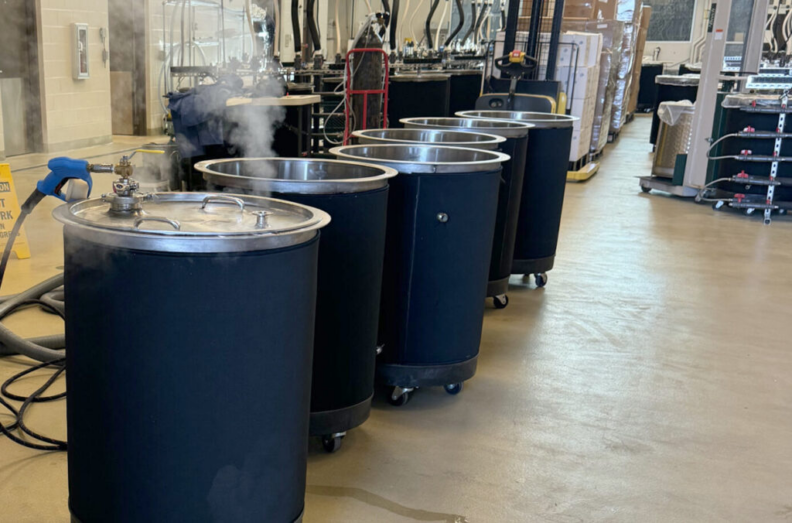
To help conserve this precious resource, Washington State University researchers recently implemented a new “clean-in-place” system to sterilize fermentation tanks in the Ste. Michelle Wine Estates WSU Wine Science Center.
“This is a big step toward sustainable practices,” said Jim Harbertson, associate professor in the Department of Viticulture and Enology (V&E) at WSU Tri-Cities. “It’s extremely gratifying to see the tanks cleaned this way. We’re using the greenest possible chemical — water — and we’re using less than a percent of what is typically used.”
When it’s time for sterilization, the tanks are individually rolled to a section of the Wine Science Center that’s demarcated for safety. There, equipment is attached to the tank, the tank’s lid is secured, and the inside of the vessel is sterilized with steam. After sterilization is complete, the remaining water is vacuumed out and used to clean the next tank in line.
The tanks are uniquely designed: None include conventional escape valves for draining liquid, and each has been electropolished, resulting in a special grade of steel that’s extremely smooth and easy to clean.
“Enabling this system has removed some pressures from me,” said winemaker Madelyn Calderon. “I know that the tanks are sanitized and can be assured that whatever I put in there next is going to a safe environment.”
In addition to saving water, the clean-in-place process is simpler than conventional methods. Previously, cleaning the small fermentation tanks at the Wine Science Center involved tipping them over to drain the liquid, which was both impractical and unsafe. Sanitizing agents and chemicals were also used, requiring that the tanks be filled at least halfway with water.
WSU’s V&E department sterilizes its tanks many times throughout the year. They’re cleaned frequently during the height of harvest, when the team is consistently making new batches of wine. As a precaution, the tanks are also sterilized at the beginning of the winemaking season after sitting empty for months.
Harbertson noted that sterilization is especially critical in a research environment such as WSU’s Wine Science Center.
“In a research scenario, a lot rides on having complete control of the fermentation,” he said. “It’s important to ensure we’re fermenting the wine with the organisms we purposely put there.”
Employed by industries like dairy, food processing, and pharmaceuticals for years, it’s only recently that the innovative technology has caught on in the winemaking space. Harbertson hopes WSU can serve as an industry leader for winemakers curious about implementing the technology in their own wineries.
“Our job is to help guide the wine industry,” Harbertson said. “Many winemakers are adopting a more cautious approach to water usage, and many are looking for different strategies that lessen the burden on our resources. I think it’s good that we’re altering our processes now.”
The clean-in-place system is just part of what makes the WSU Wine Science Center a cutting-edge research facility. Scientists are installing new software and hardware for the winery’s fermentation system. They’ve also updated many of the wine tanks’ automation ports, making it easier to send instructions to the tank and more user-friendly for the winemaking team.
“We’re consistently pushing forward,” Harbertson said. “This system is a key part of our evolution into a much more modern, automated winery.”