At WSU, our faculty make contributions to the research enterprise every day of the year. These faculty are not only outstanding in their fields, but their research and creative practice reaches out from the university to the public we serve making real impacts on the lives of people in Washington and beyond. Each month the Office of Research will highlight some of our talented faculty discussing their research and creative practice in their own words.
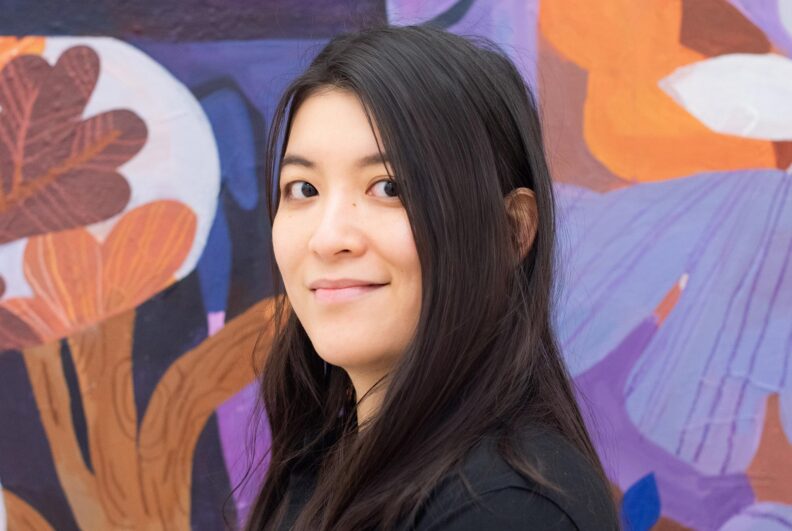
Jiemei Lin, assistant professor, Department of Art
College of Arts and Sciences, WSU Pullman
What are you currently researching? Do you have a particular artwork that you have used research to help inform your design?
My current research focuses on using visual communication to tell stories, helping audiences of all ages navigate issues of social justice and identity. I believe that art and creative expression should be inclusive, which is why my creative work may seem unconventional within academic settings.
My work primarily takes two forms: large public art and children’s book illustration. Public art is inherently accessible and fosters social engagement. Since 2016, I have been painting and organizing large public murals across Washington state. These murals serve as spaces for dialogue, bring unique visual elements to communities, and provide opportunities for people to gather and participate.
One of my most recent projects was a two-story indoor mural in the new Amazon office in downtown Seattle. Currently, I am working on three indoor installations for Groff Elementary School in Moses Lake. These pieces will honor the history of Moses Lake and reflect our respect for nature and the land. Additionally, I am organizing a large outdoor mural for the WSU Children’s Center and another for Kamiak Elementary School in Pullman, both of which are planned for summer 2025.
In the realm of children’s books, author Kao Kalia Yang and I recently published our first collaboration with Lerner Publishing, The Rock in My Throat, a picture book memoir that tells the story of young Kao Kalia’s struggle to speak English as a newly arrived refugee from the Hmong community in Laos. Additionally, my board book Goodnight, Zodiac Animals, published by Candlewick Press, is now available for pre-order. Written and illustrated by me, it is a colorful and soothing exploration of the Chinese zodiac animals and how they go to sleep. Both books aim to engage underrepresented groups by telling the stories of minority children in the U.S.
Your artwork takes on themes of individual and cultural identity. What messages are you looking to convey through these themes? What made you interested in these particular themes?
The message is simple: Everyone is unique and complex. Everyone deserves to be loved and understood.
I grew up in Hangzhou, China, part of the generation of only children, raised by two professor parents in a highly academic, achievement-oriented environment. As a child, I was encouraged to think critically and independently. However, the rigid framework I was expected to fit into troubled me deeply—there was only one version of success: good education, prestigious degrees, and high-status jobs.
I constantly questioned authority, challenging my teachers and parents, as well as the propaganda and the scripted speeches that surrounded us. This led to a lot of trouble, but also some rare encouragement from a small number of “cool” adults. As a misfit in my class, family, and community, I often found myself defending minorities or siding with those who had less power.
Everyone is unique and complex. Everyone deserves to be loved and understood.
My family endured difficult times throughout history. One of my grandfathers, a retired ancient Chinese literature scholar, spent over ten years in a labor camp, while another lost his life during the Cultural Revolution. Through it all, my family was held together by strong women and single mothers. At the same time, my loving yet struggling family passed on not only cultural trauma but also genetic mental health issues.
For years, I’ve been creating art that navigates these personal and familial themes—exploring family history, womanhood, motherhood, and cultural identity. This process is my way of trying to understand our time and the meaning of life.
We are all healing from our experiences and learning from them. If I want to truly love someone, I need to know their stories and help tell those stories. And so here I am—still the hero and the victim, all at once. I’m still figuring things out, traveling this journey along with everyone else on Earth.
You work with both digital media and traditional media to create paintings, murals, and illustrations. How do you use design and color to convey messages in your artwork?
Perhaps I can answer this question by describing how I approach a project. Every time I start something new, I learn something new. For example, when I worked on the illustrations for The Rock in My Throat, I delved into the history of Hmong Americans, the Secret War, and the broader history of the Hmong people across Asia. I explored the visual symbols and elements that have been passed down through Hmong history. Instead of using a written language, the Hmong have preserved their stories through oral traditions, gathered around bonfires, and by creating fabric art.
I studied the color palettes of Hmong/Miao dyes throughout history, examining their symbols, embroidery, drawings, and silver objects. Meanwhile, Kao Kalia’s story takes place in the 1980s in St. Paul, Minnesota. As I researched Hmong art, I also spent time reading Sears catalogs from the 1980s, diving into piles of ’80s treasures in my mother-in-law’s basement, and rewatching John Hughes films to capture the essence of that time period.
I brought all of these experiences together in my visual language, keeping my audience in mind—children, especially children of immigrants, as well as adults who may have grown up in that era. These adults might remember wearing the same kind of sweater or having a classmate who looked different from everyone else and didn’t speak much. My goal was to create a world where everyone could find a piece of themselves.
This is a very designer’s mindset. Designers care about how their audience feels and responds to their work, and I care about that deeply, too.
How will your research have a wider impact on society?
Public art is loud, big, and free. I have been creating public art that you can find in many cities and public spaces. Children’s books, on the other hand, are the true bestsellers in the information age—because parents still buy books. I’m a little anti-social, I’ll admit, but I’m always open to hearing stories and exchanging them. There’s always someone out there waiting to be heard. The audience always carries the messages and becomes part of my work. Just as generations sat around the bonfire, I believe my art functions in the same way as a bonfire.
What drew you to WSU?
My partner, professor Joe Hedges, accepted a tenure-track position in the Department of Art in 2015 to teach painting. We moved to Pullman, and I started working as a graphic designer in the College of Education at WSU. Since 2016, I’ve become deeply involved in the community. I painted my very first mural in Pullman—the Jefferson Jaguar for Jefferson Elementary School. After that, I worked on the Kestrel mural for Kamiak Elementary School, organized and painted the Black Lives Matter mural, and contributed to a few murals in downtown Pullman.
Pullman has become not only my home but a place that holds my heart. I also had an amazing experience working with the College of Education as a graphic designer. In 2023, I applied for and was offered a tenure-track position in the Department of Art. Now, I’m working toward tenure, as an assistant professor in art, I am teaching drawing, design and illustration, marking my ninth year in Pullman, Washington.
For more information: