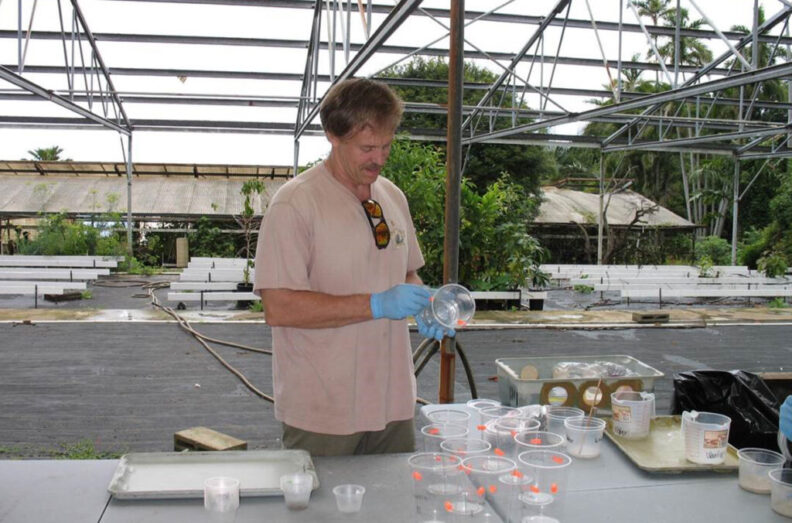
WSU Regents Professor honored with Organic Pioneer Award
John Reganold accepted the Rodale Institute’s award, given to scientists, farmers, and business leaders working to support a healthier planet.
John Reganold accepted the Rodale Institute’s award, given to scientists, farmers, and business leaders working to support a healthier planet.
A two‑year, $2.6 million U.S. Department of Energy grant will support a team of researchers in designing and building carbon-negative homes to combat climate change in the growing residential construction sector.

In the wake of a pandemic that has ties to the wildlife trade, a research team from five universities recently received a $2.75 million grant to study how biological, social, and economic factors influence the pathogen spread through animal trade networks.

A recent modelling study found that changing weather could increase suitable habitat for the brown marmorated stink bug in the United States by 70%. The study, published in Pest Management Science, draws on data from a three-year stink bug monitoring effort in 17 states as well as several potential climate scenarios. However, whether the insects will thrive in new places depends on the conditions of each area and potential mitigation measures.

A recently discovered virus in a Russian bat that is similar to SARS-CoV-2, the virus behind COVID-19, is likely capable of infecting humans and, if it were to spillover, is resistant to current vaccines.

Feeding honey to hibernating bears helped Washington State University researchers find the potential genetic keys to the bears’ insulin control, an advance that could ultimately lead to a treatment for human diabetes.

Over time the water collected behind dams will release greater amounts of methane, a greenhouse gas with even worse effects than carbon dioxide, according to a recent study.

An X‑ray beamline with a first-of-its-kind imaging source is being installed at Washington State University’s Dodgen Research Facility. The instrument, valued at over $1 million, will allow researchers to study a range of materials at nano- and atomic-scales. It’s also perhaps the only X‑ray beamline in the world to be housed in the same facility as a research nuclear reactor, facilitating the study of irradiated materials.

A little Martian dust appears to go a long way. A small amount of simulated crushed Martian rock mixed with a titanium alloy made a stronger, high-performance material in a 3D‑printing process that one day could be used on Mars to make tools or rocket parts.

John Stark, a Washington State University professor of ecotoxicology, is one of nine individuals to be selected this year as an Entomological Society of America (ESA) fellow. Stark was nominated for the lifelong honor by Laura Lavine, professor and chair of WSU’s Department of Entomology.