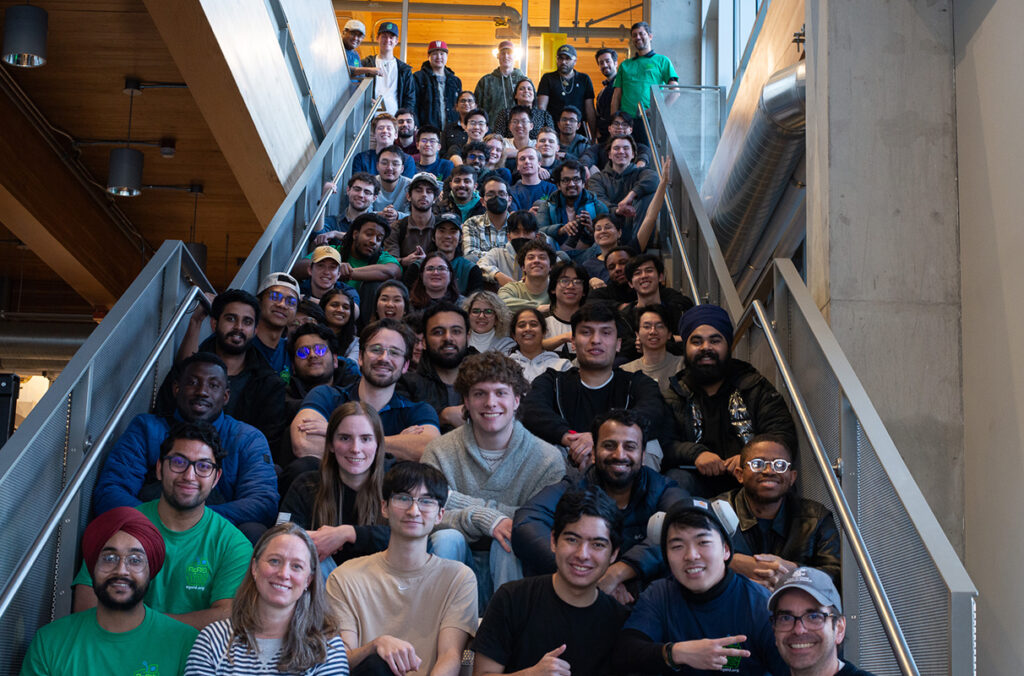
Nearly 70 students from Washington State University worked continually for 48 hours as part of the second AgAID Digital AgAthon, an event designed to apply artificial intelligence to real-world agricultural issues and to address challenges in Washington’s agriculture industry.
The event was hosted by WSU’s AI Institute for Transforming Workforce and Decision Support (AgAID), a USDA-NIFA funded institute with researchers from seven universities and an ag tech startup that works to build partnerships between AI and agricultural communities.
For Chamaporn Paiboonvorachat, a PhD student in the Biological Systems Engineering Department, the event was a marathon.
“This event was a first for me, and it opened my eyes to the power of collaboration,” she said. “I witnessed individuals unite over a common goal, coding intensely for two days to tackle real-world problems. Each person was striving to achieve their objectives within a limited timeframe. It was a fun and transformative experience.”
Participants at the event included graduate and undergraduate students from 12 majors in computer science and engineering as well as two high school students.
As part of the event, teams were given one of two agricultural challenges and had 48 hours to “hack” or come up with solutions. In one challenge students were asked to predict a daily snowpack time series, taking data and predicting water amounts for the upcoming crop growing season. Snow runoff is driven by snowfall in winter but is needed in the summer. This mismatch in timing can affect not only the agriculture industry but residents of Washington.
The second task was centered around predicting how much crop residue is found on soil. In many agricultural areas the original rich soil has been lost, and farmers and conservation agencies are interested in controlling erosion. Students were asked to create a system where an image could be taken which would be used to predict the amount of crop residue or soil on the ground.
“Being complete beginners, we spent our first day solely researching approaches to the challenge. None of our initial iterations worked, and we stayed up until midnight struggling to code a basic neural network,” said Neal Wang, one of the high school participants. “But with a good night’s sleep and fresh minds, we took to our creative sides and implemented an innovative model that few other teams used. We learned that sometimes the best solution isn’t the most obvious one and that curious experimentation can motivate great results.”
While participants gained valuable technical experience, organizers emphasized that the most crucial takeaways were skills such as teamwork and problem-solving.
“Nobody expects one person to have all the skills, and each individual will bring something to the table,” said Jordan Jobe, AgAID’s manager. “And even if they’re still developing their technical skill sets, they might have other skills like organization or communication that are very helpful. This is a really great way to quickly figure out what you enjoy.”
For those interested in further exploring AI in agriculture, the AgAID Institute offers summer internships, providing students with hands-on opportunities to work on industry-relevant projects.