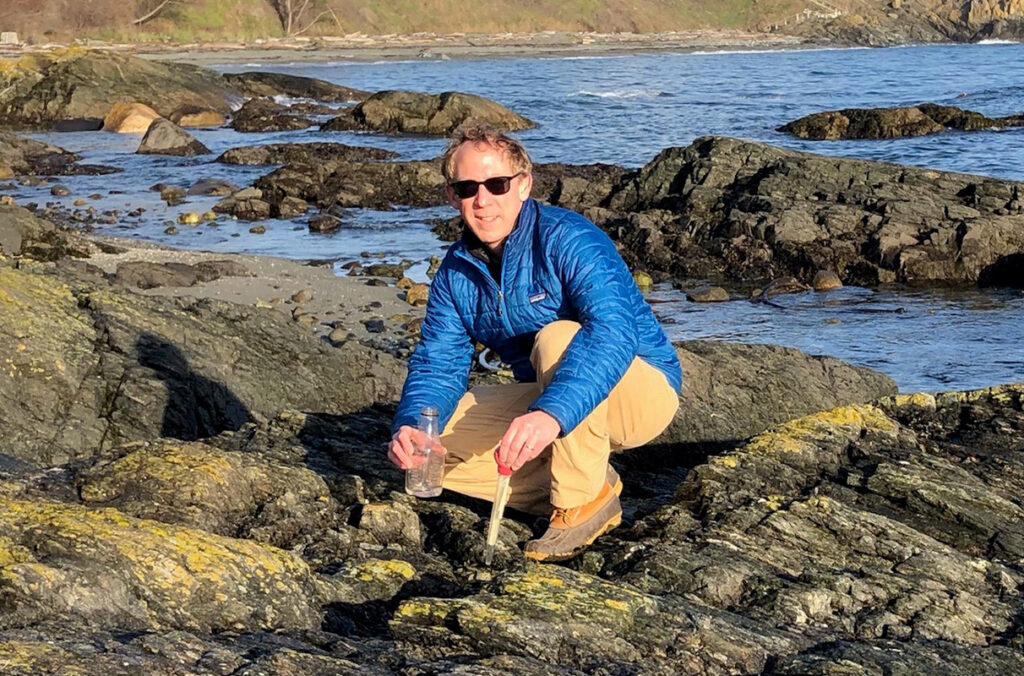
A new $1.24 million grant will enable Washington State University researchers to investigate what lessons intertidal mussels can teach about adaptability to environmental stressors.
Wes Dowd, an associate professor in the School of Biological Sciences, received the four-year research grant from the National Science Foundation to look at how extreme heat and other environmental stressors affect physiological variation among the intertidal creatures.
“The intertidal zone is one of the most dynamic environments on Earth,” said Dowd, whose work focuses on the environmental physiology of marine animals. “Most of the organisms there have marine ancestors, but they spend half or more of their lives coping with terrestrial conditions.”
Nestled where the ocean meets land, intertidal zones routinely experience drastic yet predictable changes in moisture, salinity, acidity, and temperature due to the ocean’s regular tidal action. Other environmental occurrences such as ocean upwelling or heat waves can also affect the survival of mussels and other intertidal creatures, which have to be able to respond to both these predictable and unpredictable changes in their environment.
Dowd and his collaborators are working to understand how environmental stress, specifically high temperatures, changes the amount of physiological variation among individual mussels by measuring processes from the whole organism down to the molecular level.
They will be investigating patterns of protein production in mussels exposed to extreme heat. Additionally, the research team will look at how differences in protein presence relate to measures of animal performance.
“The goal is to identify groups of proteins that work together toward a particular function and whose abundances vary more from one individual to the next when those mussels are heat-stressed,” said Dowd. “We think that only some groups of proteins will follow this pattern, and that those proteins might be involved in functions that are important for the ability that some individuals have to survive high temperatures.”
Moving forward, Dowd hopes his work will help the scientific community develop a greater understanding of the consequences of environmental stress in mussels, which could have wide-ranging implications along Washington’s coastlines.
“Mussels form a band in the mid-intertidal zone and function as ecosystem engineers, creating habitat for dozens of other types of organisms,” Dowd said. “They play crucial roles in these coastal ecosystems, and impacts on mussels could lead to system-wide changes.”