At WSU, our faculty make contributions to the research enterprise every day of the year. These faculty are not only outstanding in their fields, but their research and creative practice reaches out from the university to the public we serve making real impacts on the lives of people in Washington and beyond. Each month the Office of Research will highlight some of our talented faculty discussing their research and creative practice in their own words.
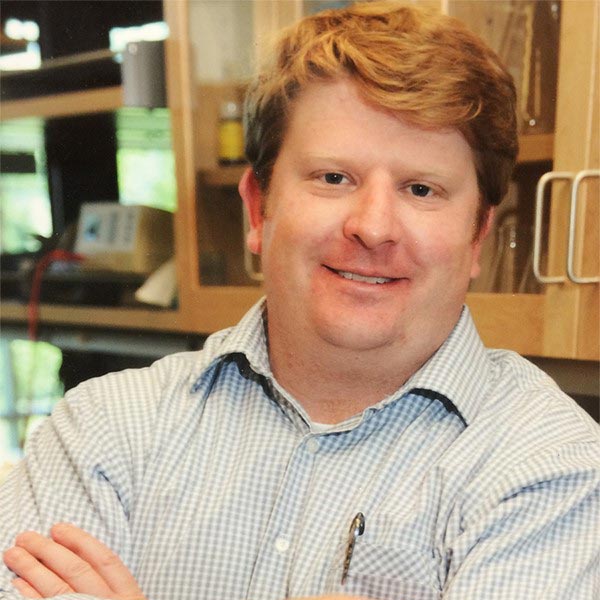
Bertrand Tanner, associate professor, Department of Integrative Physiology and Neuroscience
College of Veterinary Medicine, WSU Pullman
Also: adjunct associate professor, Voiland School of Chemical Engineering and Bioengineering, WSU Pullman
What are you currently researching?
In general, the focus of my research is molecular and cellular muscle function. We study the mechanisms regulating force production in striated muscles, which are the skeletal muscles that enable locomotion and the muscle in the heart that pumps blood around the body.
One exciting new project we are working on integrates computer modeling with single skeletal muscle fiber experiments within a virtual feedback environment that emulates muscle-tendon dynamics during contraction. The muscle-tendon interface is critical for transmitting the force generated by muscles into movement of the bones. We are interested to learn how different muscle forces are paired with different tendon properties, such as stiffness, to optimize work and power output, and thus locomotion. We are trying to test how the proper pairing of these properties enables efficient movement. Conversely, as the muscle-tendon properties become mismatched, it is likely to compromise movement. However, until we measure and describe this coupling between the muscle and tendon, it is difficult to fix it or improve the mismatch, which likely occurs with neuromuscular or musculoskeletal diseases.
We have some cool cardiac muscle studies going on as well, a portion of which I’ve described below.
You have a background in physics, bioengineering, computational biology, and biomechanics, and your research touches both the College of Veterinary Medicine and Voiland College of Engineering and Architecture.
How does this multidisciplinary approach and perspective play into your work?
I’ve always been interested in trying to use mathematics to describe biological systems. Using mathematics and computational modeling to frame the molecular and cellular mechanisms of contraction is interesting and difficult. I feel that a mathematical model of contraction is a very specific hypothesis on how muscles work. And like all models, these models are not 100% correct because we cannot include every detail. Nonetheless, the details we do include can be useful to test very specific ideas about muscle function.
On the flip side of the lab, we have our experimental approaches to make real measurements about how muscles work. However, our measurements cannot clearly sample the exquisite set of molecular and cellular processes that underlies muscle function because many of these processes are coupled. These experimental observations are very useful for informing our models and test model predictions.
Learning from the models and the experiments helps each side of the lab become better and more focused with the hope of better defining the physiological mechanisms of contraction.
What are some innovations you are hoping to see in the future as a result of your research?
One insightful project that is coming together is spearheaded by Kyrah Turner, a terrific Ph.D. student in my laboratory. Kyrah has been working with a new set of transgenic mice that she has developed. We are hopeful that this new set of mice will enable us to measure molecular interactions between two important muscle regulatory proteins within the cardiac cells. The proteins are called regulatory light chain and myosin binding protein-C.
Other labs across the world have worked with these proteins before, but few have looked at their interactions within the muscle cells. Some labs have studied the biochemical interactions of these proteins, but only in solution using the isolated proteins or fragments of them, which isn’t their native environment.
We are confident that the structural organization of the muscle, at the molecular and cellular level, will influence how these proteins interact and regulate force production in the heart. I’m excited to see what we find, and hopefully our studies will help understand the detailed mechanisms that underlie cardiac contractility, ultimately helping to inform therapeutic targets to treat heart failure in human patients.
How will your research improve or have a wider impact on society?
I see our research efforts having two important impacts. Foremost is the impact that our research makes related to student training. I approach student training in my laboratory very seriously because the future contributions of these young scientists represent the next 30-40 years of new scientific, technological, and research developments in the world. Every day I work to build a welcoming, inclusive, challenging, team-based training environment—with rigorous expectations—to teach cutting-edge research techniques, critical thinking, and analytical problem solving to the next generation of scientists who work in my laboratory. We are striving for excellence in all our research endeavors, including student training. Hopefully, this carries forward and into the next exciting career directions that my students pursue.
Every day I work to build a welcoming, inclusive, challenging, team-based training environment—with rigorous expectations—to teach cutting-edge research techniques, critical thinking, and analytical problem solving to the next generation of scientists who work in my laboratory.
The second relates to a long-term goal of better understanding normal physiology, so we can better describe and inform dysfunctional physiological processes that underlie disease.
I think of our work as a mechanic who fixes a car, or more specifically the engine in the car. We are trying to figure out how the motor works, and sometimes how the motor and transmission work together to facilitate movement. When the engine breaks or isn’t running properly, we take our car to the shop and the mechanics fix the problem because they can diagnose what is wrong and properly put it back together.
Our work is no different—other than the fact that we don’t know enough nor understand the thorough details about how the engine works to drive skeletal and cardiac muscle contraction. This makes it hard to fix the problem if you don’t know how it is supposed to work under normal conditions. The molecular basis of contraction has many moving parts that work in concert to facilitate normal physiological function. Many muscle diseases arise when the molecular mechanisms of contraction become dysfunctional, and the proteins do not interact properly to enable normal contraction and relaxation. The research we perform holds potential to ultimately guide innovative approaches to ameliorate dysfunctional contraction with disease.
What drew you to WSU?
I love the outdoors. I don’t particularly like cities. It is nice that WSU Pullman is in a small town with excellent research resources. I love how simple life is here in Pullman, and how nice it is for raising a family. I go to work. I come home. There isn’t much more to worry about, which keeps life simple and focused. I miss the great foods and diverse tastes that many larger cities offer, but I always put those flavors on my ‘to do list’ when traveling. The ease of getting to hikes, camping, rivers, skiing, biking, etc., for the outdoor fun around the Palouse and surrounding areas is second to none. Getting outdoors keeps me smiling, and I relish how accessible it is being here at WSU.
For more information: