Welcome to Challenge 9 of WSU’s Research Impact Challenge!
Challenge 8 looked at the h-index, a calculation of author productivity and impact. Challenge 9 will look beyond citation-based metrics, considering the ways that alternative metrics (or “altmetrics”) can add to the picture of what we know about the impact of scholarship.
Let’s get started!
Background
The term “altmetrics” was coined in 2010 in “altmetrics: a manifesto” and is defined as “the creation and study of new metrics based on the social web for analyzing, and informing scholarship.” (Priem, Taraborelli, Groth, and Neylon, 2010).
It’s easy to assume that altmetrics are all about social media (people tend to think of X, formerly known as Twitter, in particular), but that is only part of what they offer. By tracking links from all kinds of websites back to scholarly research, altmetrics can reveal references to and engagement with scholarship in the news, in policy documents, in syllabi, on scholarly blogs, and beyond.
Challenge 9 introduces you to altmetrics tools.
Here’s how to do it
Altmetric is a subscription service altmetric tool. Altmetric searches the web for “mentions” of research outputs, such as journal articles or book chapters, to show how readers are engaging with scholarly publications online. Mentions can appear in social media, scholarly blogs, news outlets, Wikipedia, citation managers like Mendeley, and more (read more about which sources Altmetric is tracking).
You may have seen Altmetric donuts, badges, and scores on journal websites, perhaps even attached to your own research. Each stripe of color on the donut represents a different type of engagement. For example, light blue indicates Twitter, red indicates news, and yellow indicates blogs. If you hover over the donut, you’ll see an abbreviated summary of engagement with the work.
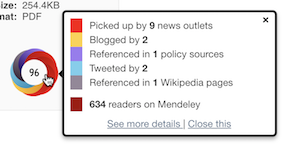
The Altmetric score of attention—the number inside the donut—is a proprietary number generated by both counting and weighting the value of different types of mentions. Altmetric describes the attention score as an “indicator of engagement.” The score of attention does not communicate anything about the quality of the work. To learn more about the score of attention, see Altmetric’s support page, “How is the Altmetric Attention Score Calculated?“
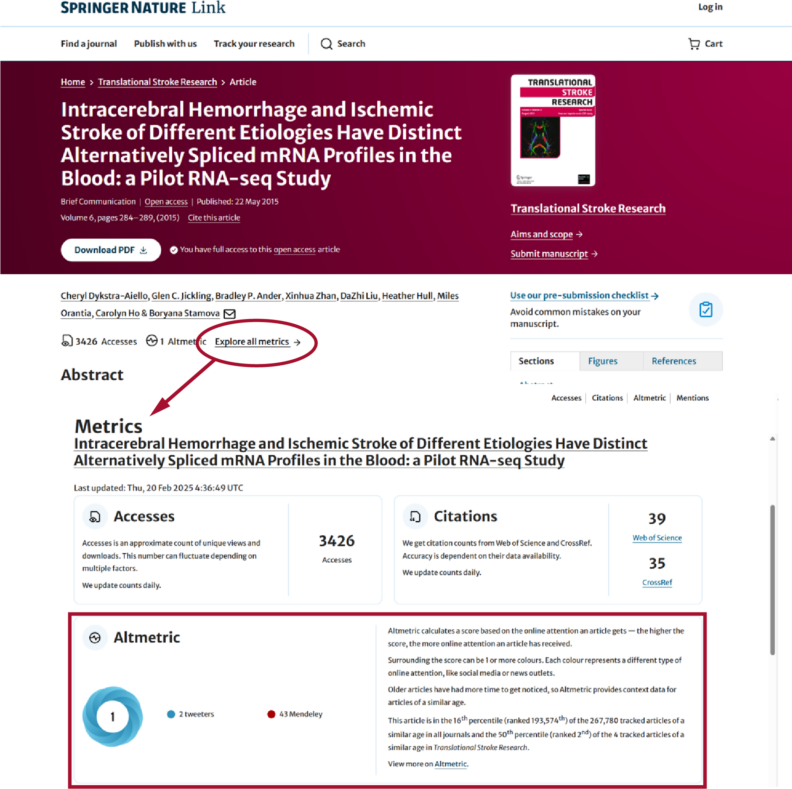
Although, WSU does not currently subscribe to Altmetric, you may still see Altmetric data on your published article(s)’ journal’s website. An example of this can be seen in this screenshot:
In addition to Altmetric today’s challenge activity focuses on two OpenSource metric tools. In order to better understand these platforms, click on the links below and investigate. As you navigate the platforms, consider that one of the takeaways of the h-index challenge activity was that metrics depend on the data source used for the calculation. Do you notice any differences in the results between the platforms?
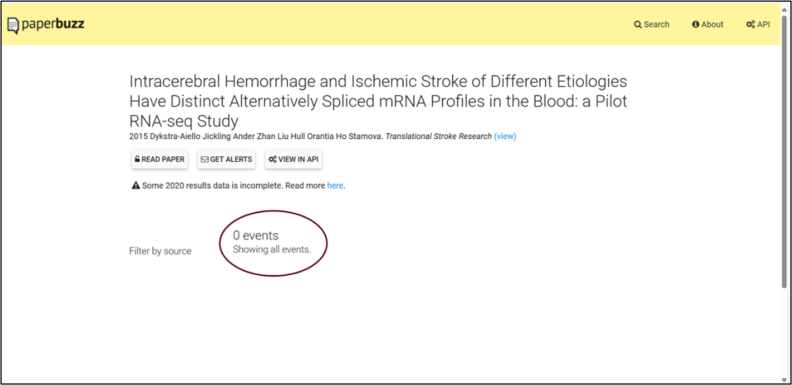
- PaperBuzz.org is based on Crossref Event Data to track article “buzz” online through social media and data that an author has linked on-line. For more information about this platform, see Nature Index’s article, “New tools track article buzz online” . Here’s a screenshot of information for the same article that was shown above. Notice that, whereas the journal itself showed an altmetric, the metrics on this platform does not.
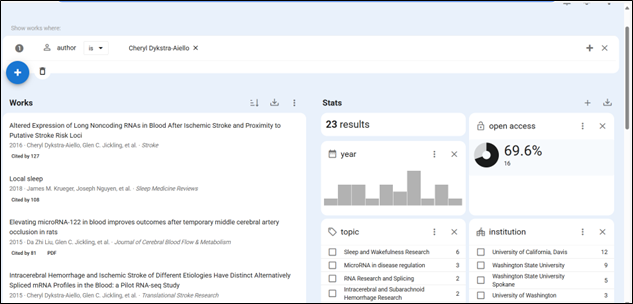
- OpenAlex is a comprehensive catalog of scholarly papers, authors, institutions, and more. For more information, see Nature’s “Massive open index of scholarly papers launches” and Financial Times’ “Sorbonne’s embrace of free research platform shakes up academic publishing”. As an example of what information is available on this platform, here is a screenshot of search results:
What next?
- Wondering how to use altmetric data in a practical and responsible way?
Learn more
- Barnes, C. (2015). The Use of Altmetrics as a Tool for Measuring Research Impact. Australian Academic; Research Libraries, 46(2), 121–134. DOI: 10.1080/00048623.2014.1003174.
- Wilsdon, James & Bar-Ilan, Judit & Frodeman, Robert & Lex, Elisabeth & Peters, Isabella & Wouters, Paul. (2017). Next-generation metrics: responsible metrics and evaluation for open science. DOI: 10.2777/337729.
- Christian, Kathy & Adie, Euan & Derrick, Gemma & Didegah, Fereshteh & Groth, Paul & Neylon, Cameron & Priem, Jason & Xu, Shenmeng & Zahedi, Zohreh & Theng, Yin-Leng & Hassan, Saeed-Ul & Aljohani, Naif & Bowen, Timothy & Patel, Vanesh & Haunschild, Robin & Bornmann, Lutz & Taylor, Mike & Ross, Liesa & Konkiel, Stacy. (2020). The State of Altmetrics: A Tenth Anniversary Celebration. DOI: 10.6084/m9.figshare.13010000.v2.
Preparing for the next challenge
Congratulations! You’ve completed Challenge 9 of the WSU’s Research Impact Challenge, and we’re almost to the finish line—just one more challenge to go! Challenge 10 will aim to prepare you to take your new knowledge and skills back out into the world by introducing frameworks for the responsible and ethical application of research impact metrics.